
Press Releases
Intepro Systems News
Automated Test Equipment (ATE) in Advancing Power Electronics
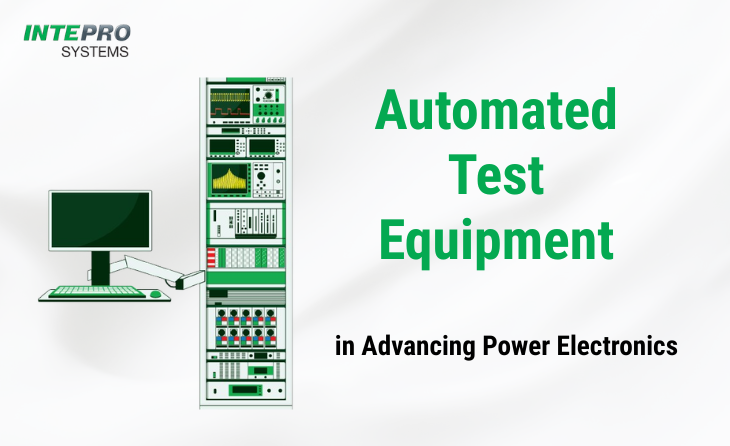
Power electronics has become the foundation of modern infrastructure providing energy for a wide range of applications. As these applications growing increasingly manufacturers and developers are now challenged to design not only functional products but also systems that are efficient, reliable, and durable. Automated Test Equipment (ATE) has become a critical part of how the industry to make manual processes into fast, repeatable, and highly accurate testing workflows.
Role of Automated Test Equipment (ATE) in Product Development and Manufacturing
Automated Test Equipment (ATE) doesn't just belong on the production floor it supports the entire product lifecycle. From early design validation and prototype testing to full-scale production runs and quality assurance, automated testing brings consistency to every stage.
One of its biggest contributions is repeatability. Every unit gets tested the same way, with the same parameters, every time. That consistency shortens development cycles, reduces manufacturing bottlenecks, and makes it far easier to demonstrate compliance with industry standards and safety certifications.
Key Parameters Tested in Power Electronics
When it comes to testing power electronics, there's no single metric that tells the whole story. ATE systems are designed to look at several dimensions together:
• Electrical performance: This is the baseline question: does the device actually do what the datasheet says? Testing covers voltage accuracy, current handling capacity, power output, and efficiency across a range of load conditions, not just at nominal operating points.
• Thermal and reliability: A device that works fine at room temperature on the bench may behave very differently after hours of operation under load. This testing looks at how the device handles sustained heat, thermal cycling, and the kind of long-duration stress that simulates years of real-world use compressed into a controlled test window.
• Dynamic performance: Power electronics switch at high speeds, and what happens during those transitions matters. Transient response times, switching behavior, and harmonic distortion levels all need to be within acceptable limits, because if they are not, grid compatibility issues and EMI problems tend to follow.
• Safety and compliance: This one is non-negotiable. Insulation integrity, overload protection, and short-circuit behavior all need to be tested and verified against the relevant regulatory requirements before a product goes anywhere near a customer. There is no reasonable shortcut here, and any that is taken tends to surface at the worst possible time.
Types of Power Electronics Tested Using Automated Test Equipment (ATE)
The range of devices that go through Automated Test Equipment (ATE) is broad. AC and DC power supplies, DC/DC converters, inverters, and UPS systems are staples. Beyond that, Automated Test Equipment is increasingly used for EV chargers and battery systems, semiconductor power devices, solar inverters and other renewable energy equipment, and industrial motor drives.
Each device type has its own unique test requirements which is why flexible, configurable ATE platforms matter. Software like PowerStar from Intepro Systems lets engineers build and manage automated test sequences without writing low-level code, making it easier to adapt setups across different product lines without starting from scratch.
Benefits of Automated Testing in Power Electronics
The impact of ATE isn't limited to the test floor it shows up across the business:
• Better product quality: consistent, repeatable testing means fewer defects making it out the door
• Lower operational costs: less reliance on manual labour and fewer production errors add up quickly
• Faster time-to-market: validation moves faster, and development cycles shrink accordingly
• Stronger reliability and safety: defects get caught earlier, and compliance testing runs the same way every time
• Room to grow: modern ATE platforms are built to adapt, so as power electronics technology evolves, your test infrastructure doesn't become a bottleneck
Company Contact:
Intepro Systems, Inc.
Andrew Engler
(714) 953-2686
14662-E Franklin Avenue,
Tustin, CA 92780
Agency Contact:
Futurism Technologies, Inc.
30 Knightsbridge Road, Suite 525, Piscataway, New Jersey 08854, USA.
Tel: +1 (732) 790-2938
Fax: +1 (302) 351-8845
Products
Support
Company