
Press Releases
Intepro Systems News
Choosing the Right Battery Test System for Your Application
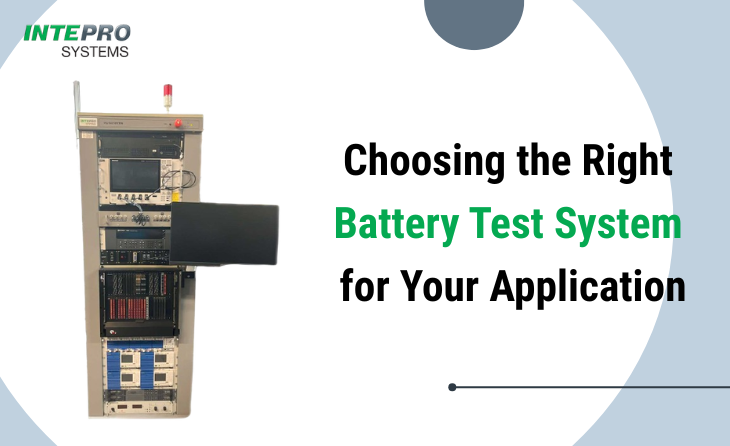
Battery test systems have moved well beyond basic charge and discharge cycles. Modern battery test equipment needs to handle complex chemistries, high voltages, bidirectional power flow, and increasingly stringent safety and certification requirements. Choosing the right system upfront is one of the more consequential decisions an engineering team can make.
Why Getting the Right Battery Test System Matters
The wrong battery test system does not just slow down your program. It can produce unreliable data, miss critical failure modes, or create safety risks that only surface later in the product lifecycle. Battery failures in the field are expensive and, depending on the application, potentially dangerous.
Beyond safety, the right system also affects how quickly you move from development to production. A battery simulator test system that integrates cleanly with your existing automated test software and workflows can cut validation time significantly.
Where Battery Test Systems Are Used
Battery testing looks very different depending on the industry. Here is a look at where these systems are most commonly used:
Electric Vehicles (EV): EV battery packs run at high voltages and withstand a lot of degradation in everyday use. Testing processes must address quick charge cycles, thermal stress, and long-term cycle life, so engineers can be assured that the pack works the same way on the road as it did on the bench.
Aerospace and Defense: Batteries used in aircraft, satellites, and defense systems go through some of the harshest conditions imaginable. Testing covers extreme temperature ranges, high-vibration environments, and long storage periods, and every result needs to be documented, repeatable, and ready to hold up under a certification audit
Energy Storage Systems: The only way to know how a grid-connected storage system will really perform is to test it the way it actually operates. That means bidirectional test setups and putting the system through thousands of charge-discharge cycles over extended periods, not a handful of bench runs under ideal conditions
Industrial Batteries: Batteries in forklifts, backup power systems, and heavy machinery do not get a break. They face sustained, high-current demands shift after shift. Test equipment for these applications needs to be just as hardworking, capable of running long, continuous programs without becoming a reliability problem of its own
Key Factors to Check Before Selecting a Battery Test System
These are the factors that tend to matter most in practice:
Voltage and Current Range: The system needs to cover your full operating envelope, including peak charge and discharge conditions, not just the nominal values in your spec
Bidirectional Capability: Testing EV batteries or energy storage systems requires programmable DC power supplies that can both source and sink current. Regenerative systems that return energy to the grid rather than burning it off as heat make a real difference at high power levels
Software and Automation: A hardware-independent software platform gives your team flexibility without being locked to one vendor. Automated test software should handle sequencing, data logging, and reporting without custom scripting for every new test
Scalability: Modular ATE test systems that support parallel channel configurations are far easier to grow as requirements evolve than fixed, single-purpose architectures
Safety Features: Overvoltage, overcurrent, and thermal protection are baseline requirements when working with high-energy battery systems, not optional extras
Intepro Systems' battery test systems, paired with the SM15k bidirectional programmable DC power supply and PowerStar automated test software, are built to address these requirements across demanding applications.
Common Mistakes When Choosing Battery Test Equipment
Here are the most common ones to watch out for:
Underspecifying Headroom: Batteries do not always behave predictably under edge-case conditions. Building in margin is just good practice
Overlooking Software Compatibility: Hardware that does not integrate with your existing environment creates manual workarounds that slow teams down and reintroduce human error
Choosing a Fixed Architecture: Rigid systems become bottlenecks faster than most teams expect as test requirements change
Ignoring Regenerative Capability: Non-regenerative electronic loads waste significant energy at high power levels. The operational cost difference adds up over a full test program
· Using Generic Test Profiles: Equipment that cannot replicate your specific load conditions will give you lab results that do not hold up in the real world
Company Contact:
Intepro Systems, Inc.
Andrew Engler
(714) 953-2686
14662-E Franklin Avenue,
Tustin, CA 92780
Agency Contact:
Futurism Technologies, Inc.
30 Knightsbridge Road, Suite 525, Piscataway, New Jersey 08854, USA.
Tel: +1 (732) 790-2938
Fax: +1 (302) 351-8845
Products
Support
Company