
Press Releases
Intepro Systems News
DC Power Supplies: Selection Guide for Industrial and Test Applications
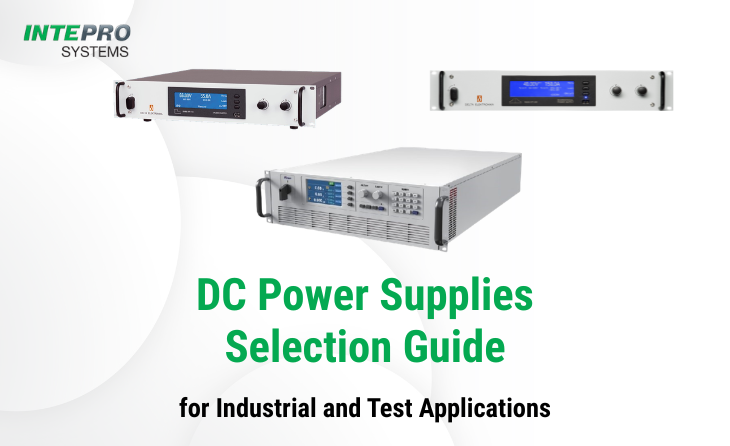
Choosing the right DC power supply sounds simple until you are actually doing it. With so many specifications to evaluate and applications to account for, it is easier than you might think to pick the wrong supply. When happens the consequences show up fast like failed tests, damaged equipment, or production downtime.
What Is a DC Power Supply and Why Does Selection Matter?
A DC power supply takes AC power from the mains and converts it into a stable, regulated DC output that electronics and industrial systems can actually use. Modern programmable DC power supplies go a step further, giving engineers the ability to set voltage and current levels digitally, automate test sequences, and monitor output in real time.
A poorly matched power supply can skew measurement accuracy, damage the device under test, or create safety risks that are hard to trace back to the source. Getting the selection right from the start is one of those decisions that quietly saves a lot of time, money, and frustration later on.
Key Parameters to Consider While Selecting DC Power Supply
Before you start comparing products, it helps to get your requirements down on paper first. Here are the specifications that matter most:
• Output voltage and current range: Your supply needs to cover the full operating window of your application, not just the typical load but the peaks too
• Power Rating: A good rule of thumb is to size with 20 to 30% headroom above your maximum load; running a supply at its limit consistently is a shortcut to early failure
• Ripple and Noise: Low ripple, measured in mV rms, matters more than most people initially expect; even small fluctuations can affect sensitive electronics and throw off measurements
• Transient Response: This tells you how quickly the supply recovers when the load suddenly changes; in dynamic test environments, a sluggish response causes real problems
• Programmability: If your workflow involves automated or repeatable test sequences, this stops being a nice-to-have and becomes a hard requirement
Types of DC Power Supplies
Understanding the different types helps narrow the field considerably:
• Linear power supplies: Clean, low-noise output with excellent stability; the go-to choice for analog circuits and RF applications where noise is a serious concern
• Switching power supplies: More efficient and compact than linear designs, making them well-suited for general industrial use where space and heat dissipation matter
• Programmable DC power supplies: Digitally controlled with remote interface support across GPIB, USB, and LAN; built specifically for test environments where automation and repeatability are non-negotiable
• Bidirectional and regenerative DC power supplies: Unlike standard power supplies that only push power out, bidirectional power supplies can both source and sink current. That means energy from the device under test gets fed back into the grid rather than burned off as heat
Intepro Systems covers this range with products like the ADG series programmable DC power supplies and the SM series, from the SM800 up to the SM15k for high power bidirectional applications. The ANEVH Series improves the higher power with units start at 30 and 50kW.
Industrial and Test Applications
Industrial and Test and measurement use cases include:
• Battery charging and formation testing
• Electroplating and surface finishing
• Telecommunications infrastructure (typically 48V DC systems)
• EV and automotive component validation
• Power electronics validation (converters, inverters, motor drives)
• Burn-in and accelerated life testing
• Compliance testing per IEC, MIL-STD, and automotive standards
Common Mistakes to Avoid
• Under sizing the power rating without accounting for peak loads
• Ignoring ripple specifications on noise-sensitive applications
• Overlooking interface compatibility with existing test software
• Choosing a single-channel unit when a multi-channel integrated power supply would reduce cost and complexity
Company Contact:
Intepro Systems, Inc.
Andrew Engler
(714) 953-2686
14662-E Franklin Avenue,
Tustin, CA 92780
Agency Contact:
Futurism Technologies, Inc.
30 Knightsbridge Road, Suite 525, Piscataway, New Jersey 08854, USA.
Tel: +1 (732) 790-2938
Fax: +1 (302) 351-8845
Products
Support
Company