
ATE Test Systems
Turnkey automated test systems for power supplies, batteries, motor drives and power semiconductors.
An automated test system is specified from the requirement rather than assembled from a catalog. What you are testing, what you have to prove, and how fast you have to prove it determine the architecture — and those three answers rarely point at the same hardware twice.
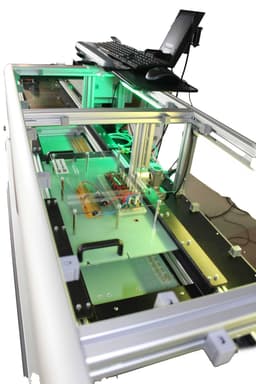
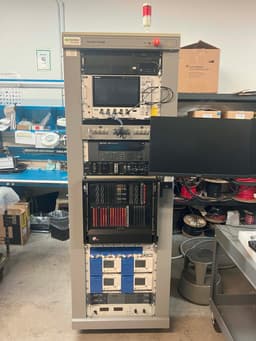
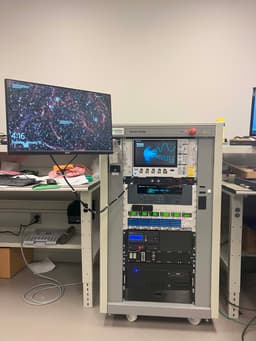
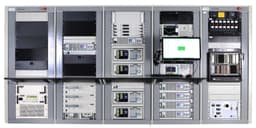
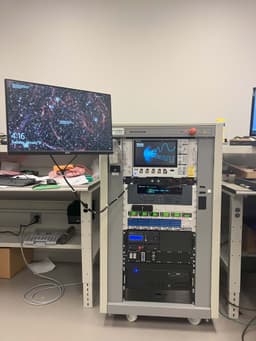
Intepro builds these as integrated racks: source, load, measurement, switching, fixturing and the test executive that drives them, delivered against an agreed acceptance procedure.
The term covers a wide range. At one end, automated test equipment is a bench instrument running a stored sequence. At the other it is a cabinet installation that takes a unit from a conveyor, powers it through a qualification profile, records every reading against a limit, and hands back a pass or a fail with the evidence attached. What makes both ATE is that the sequence, the limits and the record are defined once and executed identically every time — the point is repeatability, not automation for its own sake.
For power electronics the architecture is shaped by one thing that does not apply elsewhere: the system has to both supply and absorb real energy. A source drives the unit under test, a load absorbs its output, and above a few kilowatts the question of where that absorbed energy goes stops being academic. Dissipate it and you have bought a cooling problem and a standing electricity bill; regenerate it and you have returned it to the supply. That single decision drives the room, the ventilation, the switchgear and the running cost more than the instrument choice does.
Four things decide whether a system earns its cost, and only one of them is the hardware. Channel count sets the calendar, because a queue of units through a fixed sequence is a throughput problem rather than a power problem. The test executive decides whether the system survives its own instruments reaching end of life. Fixturing decides how much of the cycle time is a person connecting things. And the acceptance procedure decides whether delivery is an event or a negotiation.
The make-or-buy question usually turns on the second of those. Assembling instruments is not difficult; writing, validating and then maintaining a decade of program-specific sequences, limits and operator flows is where the real cost sits, and it is the part that does not appear in a bill of materials.
Find equipment by specification
Filter by power, application, standard or part number.
6 of 6 systems
- Procyon PTS 2100-20 Battery Test System5 kW – 480 kW
Scalable bi-directional charge/discharge battery test system — regenerative power stage at better than 93% efficiency, configurable from a desktop unit up to a full test floor.
- CTS4000 8-Channel Battery Cycler
High-accuracy eight-channel battery cycler, analyser and capacity tester built for cell formation and grading.
CTS4000
- PowerStar Test Executive Software
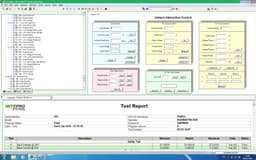
Test executive software that runs the rack — sequences, limit trees and operator flows built without writing code, with more than twenty years in production test.
- SemTest Power Semiconductor Reliability ATE
Power-semiconductor reliability ATE for SiC and IGBT qualification — high-voltage bias held across a lot of devices for the full stress duration, with per-device leakage monitoring.
SemTest HT80
- Vega Series Customizable Power Racks15 kW – 480 kW
Customizable high-power racks built from 15 kW 3U regenerative loads and DC supplies — mixed and matched to the test requirement rather than bought as a fixed configuration.
PSI 9000 DC Source Rack · Bi-directional DC source rack · High-power regenerative DC load rack
- Accelerated Life & Burn-in Test Systems
Accelerated life, burn-in and environmental stress screening rigs built around regenerative loads, so the energy the test consumes is largely returned to the mains instead of dissipated as heat.
Choosing between them
Throughput is usually the constraint
Programs size systems on power and then wait on channels. If the work is a queue of units through a fixed sequence, channel count sets your calendar.
The executive matters more than the instruments
Instruments are replaceable. A decade of program-specific sequences, limits and operator flows is not. That is where migration cost lives.
Specify acceptance up front
An agreed acceptance test procedure written before the build is the difference between a delivery and a negotiation.